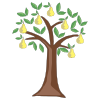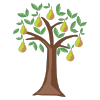
Pear trees are the elegant workhorses of the orchard, prized as much for their snowy spring blossoms as they are for their honey-sweet, meltingly tender fruit. Whether you’re looking at a towering heirloom in an old garden or a modern dwarf variety on a patio, these trees bring a distinct character to any landscape.
Growth and Appearance Pear trees belong to the genus Pyrus and are surprisingly resilient.
The Canopy: Most varieties naturally grow in an upright, pyramidal shape, making them more vertical and "tidy" than the sprawling reach of an apple tree.
Foliage: They sport glossy, heart-shaped green leaves that often turn brilliant shades of burgundy, orange, or gold in the autumn.
The Bloom: In early spring, the tree becomes a cloud of white flowers. While beautiful, be forewarned: unlike the sweet scent of apple blossoms, pear flowers have a muskier, sometimes "earthy" aroma.
The Fruit: A Patient Science Pears are unique among fruits because most varieties do not ripen on the tree. If left to hang until they feel soft, they usually become "mealy" or gritty inside.
Harvesting: They are picked while still hard and mature, then chilled or left at room temperature to finish ripening from the inside out.
Texture: They are famous for their "stone cells" (sclereids), which give some varieties that signature slightly crisp or grainy texture near the core.
Varieties: From the buttery Bartlett and the spicy Bosc to the crisp, water-rich Asian Pear, there is a massive spectrum of flavors and textures.
Care and Longevity Pear trees are the long-haulers of the fruit world. It is common to find "ancient" pear trees that are over 100 years old and still producing.
Sun & Soil: They crave full sun and well-drained soil but are generally more tolerant of "wet feet" (damp soil) than many other fruit trees.
Pollination: Most pears are not self-fertile, meaning they need a "buddy" (a different pear variety nearby) to swap pollen with if you want a harvest.
Pro Tip: To check if a pear is ready to eat, use the "Check the Neck" rule. Apply gentle pressure to the stem end; if it gives slightly, it’s dessert time.
How To Grow
Growing a pear tree is a rewarding "long game." While they require a bit of patience (and a partner), they are generally hardier and less prone to pests than apple trees.
Here is how to get your pear tree from a sapling to a harvest.
- Choose Your Duo Most pear trees are self-sterile, meaning they cannot produce fruit with their own pollen.
The Rule of Two: You usually need to plant two different varieties (e.g., a Bartlett and a Bosc) that bloom at the same time so they can cross-pollinate.
Space-Savers: If you have a small yard, look for a "multi-graft" tree, where 2–3 different varieties are grafted onto a single trunk.
- Timing and Location When to Plant: Late winter or early spring, while the tree is still dormant (before leaves appear).
Sun: They need at least 6 to 8 hours of direct sunlight. Without sun, you'll get leaves but very little fruit.
Soil: Pears prefer slightly acidic soil with good drainage. They hate "swampy" roots, but they are more tolerant of heavy clay than most fruit trees.
- The Planting Process Dig Big: Dig a hole twice as wide as the root ball and just as deep.
Root Check: If the tree is "pot-bound," gently tease the roots outward.
The Graft Union: Look for the "bump" near the bottom of the trunk where the tree was joined to the roots. Keep this 2 inches above the soil line. If you bury it, the top tree might grow its own roots and lose its dwarf or disease-resistant qualities.
Water & Mulch: Fill the hole with native soil, water deeply to remove air pockets, and add a layer of mulch (keeping it away from the trunk) to hold moisture.
- Ongoing Care Watering: Young trees need about 1 inch of water per week. Once established, they are quite drought-tolerant, but consistent water leads to juicier fruit.
Pruning: Prune in late winter. Focus on the "Central Leader" shape—one main trunk in the middle with branches spiraling outward like a Christmas tree. Thin out branches that grow straight up or cross over each other.
Thinning the Fruit: If the tree produces a massive cluster of tiny pears, pluck a few off. This prevents branches from snapping and ensures the remaining pears grow large and sweet
Harvesting
Harvesting pears is a bit of a psychological game. If you wait for them to get soft and sweet on the branch like an apple or a peach, you've already lost—they will be gritty, mealy, and likely rotting from the inside out.
Here is the step-by-step guide to mastering the "pear-fect" harvest.
- Know the "Window" Pears ripen from the inside out. By the time the outside feels soft, the core is usually overripe. Most varieties reach harvest maturity in late summer to mid-autumn, depending on your local climate.
Colour Shift: Look for a subtle change in the "ground colour" (the skin colour behind the red or yellow blush). It usually shifts from a dark, forest green to a lighter, yellowish-green.
Skin Texture: The skin may lose its matte finish and look slightly more waxy or smooth.
- The "Tilt Test" (The Gold Standard) This is the most reliable way to tell if a pear is ready to be picked. You shouldn't have to yank or pull.
Grasp the fruit firmly in your hand.
Lift and tilt the pear upward and sideways from its natural hanging position.
The Result: If the pear is mature, the stem will "snap" cleanly away from the branch at the natural joint. If the tree refuses to let go, it’s not ready.
- The "Chill" (Crucial Step) Most European pears (Bartlett, Bosc, Anjou) require a cold treatment to ripen properly. Without this, they may just sit on your counter and shrivel without ever softening.
Refrigerate: Put your hard, harvested pears in the refrigerator (at about 0°C to 4°C) for anywhere from two days to two weeks.
Why? The cold triggers a hormonal response that tells the pear it’s time to convert starches into sugars.
- Final Ripening (The Counter) When you are ready to eat them, take them out of the fridge and leave them at room temperature.
The Wait: This usually takes 2 to 7 days.
Speed it up: Put them in a paper bag with a ripe banana or apple. The ethylene gas from the other fruit acts like an accelerator.
- The "Check the Neck" Test How do you know it's finally time to bite in?
Don't squeeze the middle of the pear (this causes bruising). Instead, apply gentle thumb pressure to the "neck" (the narrow part near the stem). If it yields slightly to the pressure, it is ripe, juicy, and ready to eat